
Pope Francis reshaped the modern papacy through humility, reform, and a relentless focus on the poor. From his early years in Buenos Aires to his final Easter blessing in St. Peter’s Square, his story blends faith, controversy, and quiet defiance of tradition. This article traces his full journey — birth to burial — while unpacking lesser-known links between Pope Francis and public figures who crossed his path or shared headlines with him.
Biography Table
| Field | Details |
|---|---|
| Full Name | Jorge Mario Bergoglio |
| Nickname/Stage Name | Pope Francis |
| Date of Birth | December 17, 1936 |
| Place of Birth | Buenos Aires, Argentina |
| Date of Death | April 21, 2025 |
| Age | 88 |
| Nationality | Argentine |
| Religion | Roman Catholic |
| Profession/Occupation | 266th Pope of the Catholic Church |
| Years Active | 1969–2025 (priesthood); 2013–2025 (papacy) |
| Education | Philosophy degree (1963), theology degree (1970), chemical technician training |
| Parents | Mario Bergoglio, Regina Sívori |
| Siblings | One of five children |
| Notable Works | Evangelii Gaudium, Laudato Si’, Amoris Laetitia, Fratelli Tutti, Dilexit Nos, Hope: The Autobiography |
| Awards/Honors | TIME Person of the Year 2013 |
Early Life, Family & Education
Jorge Mario Bergoglio was born December 17, 1936, in Buenos Aires, one of five children raised by Italian immigrant parents. His father, Mario, worked as a railway worker and accountant, while his mother, Regina Sívori, was a homemaker who later taught her children literature and psychology despite health struggles of her own.
Regina Sívori had roots tied to Chile and faced a serious health issue that required the surgical removal of part of one lung, a hardship that shaped the family’s resilience. Young Jorge attended Jesuit schools, absorbing an education steeped in discipline, humanities, and philosophy that would define his worldview.
Before entering religious life, he worked as a chemical technician in a food-testing laboratory and took on odd jobs, including a stint as a bar bouncer. He earned a philosophy degree in 1963 and a theology degree in 1970, laying academic groundwork for his later role as a building custodian of faith within the Jesuit order.
His path toward the Jesuit novitiate began in the mid-1960s, a decision influenced by a lung infection he survived as a young man. That brush with mortality is often cited as the turning point that pushed him from secular pursuits toward a lifelong vocation in the priesthood.
Priesthood & Jesuit Leadership
Ordained a priest on December 13, 1969, Bergoglio pursued theological study in Germany before returning to Argentina to teach at the Colegio de San José. He completed his final Jesuit vows and quickly rose within the order, eventually becoming provincial superior of the Jesuits in Argentina.
His tenure as rector of San Miguel seminary during the late 1970s coincided with Argentina’s Dirty War, a period marked by dictatorship and fabricated accusations against him. He faced accusations of complicity when two Jesuit priests under his charge were imprisoned, a controversy that trailed him for years, though later accounts described his actions as an incomplete but genuine effort to protect them.
Despite the shadow of that era, Bergoglio’s doctorate-level theological study and steady leadership within the Jesuits in Argentina built the foundation for his eventual rise to the episcopate. His experience navigating crisis under dictatorship shaped the pragmatic, low-profile leadership style he carried into the priesthood’s higher ranks.
Bishop, Archbishop & Cardinal
Pope John Paul II named Bergoglio auxiliary bishop of Buenos Aires in 1992, and he was elevated to archbishop in 1998, succeeding Cardinal Antonio Quarracino. He earned the nickname “slum bishop” for his habit of living simply, riding public transportation, and prioritizing ministry among the urban poor.
He became a cardinal in 2001 and later chaired the Argentine Bishops’ Conference, expanding his influence across Latin America. His humility stood out even among the Vatican elite — he continued using public transportation and rejected the trappings typically associated with a cardinal’s office.
At the 2005 conclave following the death of Pope John Paul II, Bergoglio reportedly finished in second place during balloting behind Benedict XVI. That near-miss quietly positioned him as a future contender, though few predicted how soon his moment would come.
Papal Election (2013)
Benedict XVI’s surprise resignation triggered the March 2013 conclave, the first of its kind in roughly 1,200 years. On March 13, 2013, at age 76, Bergoglio was elected the 266th Pope, becoming the first Jesuit pope, the first pope from the Americas, and the first non-European pope in centuries.
He chose the papal name Francis, honoring St. Francis of Assisi and signaling priorities around poverty and care for creation. His ministry formally began on March 19, 2013, opening a papacy that would emphasize peace, humility, and reform over pageantry.
The symbolism of his name choice was deliberate — Francis of Assisi is remembered for renouncing wealth and embracing simplicity, themes that would echo throughout the new pope’s public life and written teachings.
Papal Style, Humility & Everyday Life
From his earliest days as pope, Francis rejected the ornate trappings expected of the office. He declined the papal apartments in favor of a simpler suite in the Vatican guesthouse, settled his own hotel bill after the conclave, and refused to use a limousine, opting instead for modest vehicles.
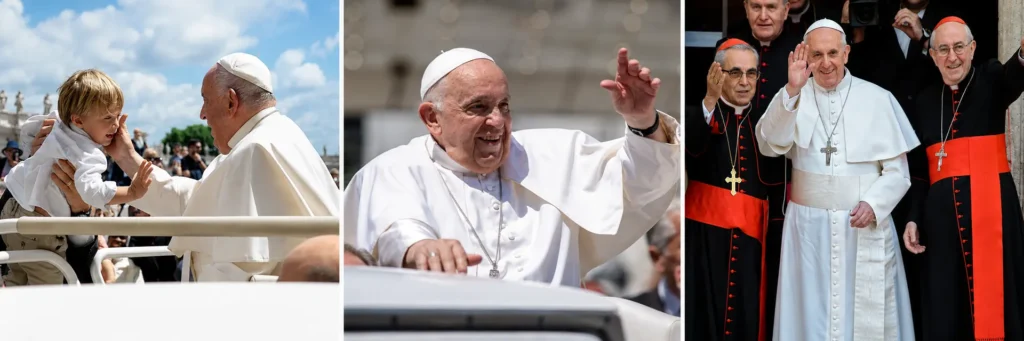
His spontaneous interactions with crowds became a hallmark of his public image — taking selfies, stopping for an elderly couple, and even visiting a record shop in Rome. These small gestures echoed the same instincts he showed as a young priest, staying close to people rather than remaining behind Vatican walls.
His signature phrase, urging priests to carry “the smell of the sheep,” captured his philosophy of pastoral closeness. He frequently prioritized time with children and everyday parishioners over formal ceremony, reinforcing an image of a pope who preferred the street to the throne.
Focus on Migrants, the Poor & Social Justice
Francis made migrants and the poor central to his papacy from the start, visiting Lampedusa in July 2013 to draw attention to those dying at sea while fleeing conflict and poverty. He repeatedly condemned what he called the “globalization of indifference” toward refugees.
In 2016, he celebrated a border Mass near the U.S.-Mexico border, a symbolic act underscoring his defense of migrants worldwide. He also established the World Day of the Poor and World Day of Grandparents to institutionalize care for society’s most vulnerable and overlooked.
As recently as January 2025, Francis addressed human dignity in the context of Italy’s migration debates and issued a letter to U.S. bishops criticizing mass deportation policy. His stance placed him at odds with several political leaders, yet he never softened his defense of migrants’ basic dignity.
Encyclicals & Major Written Teachings
Francis authored four major encyclicals during his papacy: Lumen Fidei (2013), Laudato Si’ (2015) on care for creation and the environment, Fratelli Tutti (2020) on human fraternity and social friendship, and Dilexit Nos (2024) on devotion to the Sacred Heart.
His apostolic exhortation Evangelii Gaudium, known as the Joy of the Gospel, called for a Church less focused on self-referential institutionalism and more oriented toward evangelization and outreach. Amoris Laetitia, or the Joy of Love, addressed family life and opened a controversial pathway, via a footnote, for civilly remarried and divorced Catholics to receive Communion.
Gaudete et Exsultate focused on universal holiness, while Praedicate Evangelium, an apostolic constitution issued in 2022, reformed the Roman Curia’s structure. Together, these writings reflect a consistent thread — dialogue, faith, and reform — running through his entire body of teaching.
Interfaith Dialogue & Ecumenism
Francis prioritized Muslim-Catholic relations, forging a close relationship with Ahmed el-Tayyeb, the Grand Imam of Al-Azhar, a leading Sunni leader. Their 2019 meeting in Abu Dhabi on the Arabian Peninsula produced the Document on Human Fraternity, a landmark statement on interfaith relations.
His papal visit to the region on February 4, 2019, marked one of the most significant moments in Muslim-Catholic relations in centuries. He also pursued Christian ecumenism, meeting Russian Orthodox Patriarch Kirill in Havana in 2016 — the first such meeting between a pope and a Russian patriarch in roughly 1,000 years.
Francis extended his charismatic ecumenism toward Pentecostal and charismatic movements as well, reflecting a broader ambition to bridge divides not only within Christianity but across the world’s major faiths.
Stances on LGBTQ+ Issues, Family & Social Teaching
Francis’s 2013 remark, “Who am I to judge,” regarding gay priests set an open tone that distinguished his papacy from his predecessors. While Church teaching on marriage remained unchanged, his rhetoric softened the institution’s public posture toward LGBTQ+ people.
In 2023, he called laws criminalizing homosexuality unjust and continued advocating against the death penalty as inherently against human dignity. By 2018, he had already stated that being gay was not a crime, reinforcing his consistent position across his papacy.
In late 2023, the Vatican approved blessings for same-sex couples under certain conditions, a move that stopped short of altering doctrine but was widely seen as inadmissible under previous papacies. This incremental shift became one of the most talked-about aspects of his broader social teaching.
Health Issues & Hospitalizations
Francis lived with one lung since young adulthood, a lasting effect of the lung infection he survived as a teenager. His later years brought a string of health crises: intestinal surgery in July 2021, hernia repair and abdominal surgery in June 2023, and a 38-day hospitalization at Gemelli Hospital in 2023 for bronchitis and respiratory crises.
Doctors removed roughly 13 inches of his colon during his 2021 procedure, and scar tissue from earlier operations complicated later treatment. From 2023 onward, he increasingly relied on a wheelchair and cane due to knee problems, visibly slowing his public appearances.
His final major health crisis began in February 2025, when he was hospitalized with bilateral pneumonia. He was released but remained fragile, making his final public appearances — including his last Easter blessing — all the more significant in hindsight.
Death
Pope Francis died on April 21, 2025, Easter Monday, at 7:35 a.m. local time, following a stroke and irreversible heart failure. He passed away at the Domus Sanctae Marthae in Vatican City at age 88, just one day after delivering his Easter Urbi et Orbi blessing from St. Peter’s Square.
Cardinal Kevin Farrell, serving as camerlengo, made the official announcement of his death to the world. In one of his final public moments, Francis had taken a popemobile ride through the crowds gathered for Easter, a farewell gesture that took on deep symbolic weight in the days that followed.
Funeral, Burial & What Happens Next
Francis’s body lay in state at St. Peter’s Basilica before his funeral, held according to a simplified rite he had personally requested. Departing from tradition, he was buried in a single wooden coffin rather than the historic three nested coffins of zinc and wood used by his predecessors.
His entombment took place at the Papal Basilica of Saint Mary Major on April 26, 2025, near the icon of the Madonna he frequently visited during his papacy — not St. Peter’s Basilica, where popes are traditionally buried. This choice underscored his lifelong devotion to Marian tradition.
The nine days of mourning, known as the Novendiales, preceded the conclave that would elect his successor. As with every papal transition, Rome once again became the center of the Catholic world’s attention during this period of mourning and institutional renewal.
Duke Connections & J.D. Vance Exchange
The day before his death, Francis met with Vice President J.D. Vance in a brief Easter Sunday meeting that drew wide attention given prior public friction between the two. Months earlier, in January 2025, Francis had issued a rebuke of Vance’s framing of “ordo amoris” as it related to immigration policy, a theological concept concerning ordered love that Vance had cited to defend restrictive policies affecting Vance’s children and others.
Duke University’s Dean Edgardo Colón-Emeric, a figure in Catholic-Methodist dialogue since 2017, later reflected on the reconciliatory tone of that final meeting. The Vatican’s MERCIC initiative, tied to Duke since 2022, also distributed Easter treats in a gesture connecting academic interfaith work to the pope’s final public days.
Coat of Arms
Pope Francis retained the coat of arms he used as archbishop of Buenos Aires, featuring a papal motto drawn from a homily by St. Bede: “miserando atque eligendo,” meaning “having mercy, he called him.” The phrase references the biblical calling of St. Matthew, a tax collector chosen despite his flaws.
This motto encapsulated Francis’s broader theological outlook — an emphasis on mercy over judgment — that echoed throughout his teachings on migrants, LGBTQ+ Catholics, and the marginalized more broadly.
Did You Know? Trivia
Pope Francis was fluent in Spanish, Italian, German, French, Portuguese, and English, a linguistic range that helped him connect with global audiences. He was a passionate supporter of San Lorenzo, an Argentine soccer club, and reportedly loved the works of J.R.R. Tolkien.
He became the first pope to address a joint session of the U.S. Congress and the first major world-religion leader to publicly engage causes tied to the homeless with such consistency. In 2013, TIME named him Person of the Year, and he later appeared on the cover of Rolling Stone — a rare crossover for a religious leader.
Francis also authored “The Pope Answers Letters from Children,” later a NYT bestseller, responding personally to letters like “Dear Pope Francis.” A signed Harley-Davidson gifted to him was auctioned for charity, blending his global popularity with his commitment to the poor.
Institutional Ties
Following his death, several institutions moved to honor his legacy. Duke University designated the Pope Francis Commons on Human Dignity, alongside a seven-year sustainability commitment tied to Laudato Si’ University initiatives, cementing his environmental teachings into ongoing academic programs.
Sexual Abuse Scandal Handling
Francis’s record on the sexual abuse scandal remained mixed and controversial throughout his papacy. He convened the 2019 global sex-abuse summit and later abolished pontifical secrecy around abuse cases, along with defrocking former Cardinal Theodore McCarrick following the McCarrick case investigation.
Critics pointed to grave errors, including an initial period of dismissing survivor accounts during his 2018 Chile trip, which sparked significant backlash. He later apologized directly to survivors and pushed reforms aimed at improving accountability, though many advocates argued the changes came too slowly relative to the scale of the crisis.
Documentary & Autobiography
Francis became the first sitting pope to publish an autobiography, releasing “Hope: The Autobiography” in January 2025, just months before his death. The book followed an earlier 2018 documentary, “Pope Francis: A Man of His Word,” which offered an intimate look at his worldview and daily ministry.
Notable Quotes
Among his most cited reflections, Francis spoke often about humility, poverty, the environment, and the dangers of polarization. He also repeatedly criticized the global arms trade, framing it as a moral failure that fueled conflict and deepened the very poverty he spent his papacy trying to address.
Early Odd Jobs & Buenos Aires Ministry Style
Long before becoming archbishop, Bergoglio worked as a floor sweeper, nightclub bouncer, and lab technician — jobs that shaped his grounded, working-class sensibility. Even after rising to archbishop, he continued riding public transit and preparing his own meals, refusing the comforts typically afforded to Church leadership.
This early exposure to manual labor and everyday hardship gave him a distinctive lens on priesthood — one rooted less in ceremony and more in shared struggle with the people he served.
Path to Priesthood Narrative
Bergoglio’s formative confession experience as a high schooler is often cited as the spark that drew him toward the priesthood. Decades later, his profile rose sharply after serving as relator general at the Synod of Bishops in 2001, a post-9/11 period that positioned him as a future papal contender well before the 2013 conclave.
Institutional/Campus Content
Following his death, universities and Catholic institutions held campus memorial events and papal Masses in his honor. One notable example traces back to his September 23, 2015, visit to the Basilica of the National Shrine, a site that later hosted memorial services reflecting on his broader impact on campus communities.
Pope Francis’ Celebrity Connections & Cultural Moments
Pope Francis’s global visibility meant his name regularly surfaced alongside public figures, whether through direct meetings, public tributes, or shared headlines following his death.
- Pope Francis and Tom Holland: Reports and fan discussions occasionally linked the actor to Vatican-related projects and tributes circulating after the pope’s passing, reflecting Francis’s reach even among younger, secular audiences.
- Gene Hackman and Pope Francis: The actor’s death drew comparisons in news cycles to Francis’s own health struggles at the time, with both figures making headlines within the same news cycle in early 2025.
- Tony Bennett and Pope Francis: Tributes following Bennett’s passing occasionally referenced Francis’s public statements on artists and cultural figures who championed humility and generosity.
- Michelle Obama and Pope Francis: The former First Lady met Francis during his papacy, a meeting frequently cited in retrospectives covering his diplomatic engagements with U.S. political figures.
- Shah Rukh Khan and Pope Francis: Fan communities and entertainment outlets noted parallels between the global admiration for Khan and the widespread public affection for Francis following his death.
- Bill Ackman and Pope Francis: The investor publicly commented on Francis’s economic teachings, particularly his critiques of unchecked capitalism, sparking debate among finance commentators.
- Pope Francis and Ola Källenius: The Mercedes-Benz CEO’s company gifted Francis a popemobile, a widely covered moment tying corporate philanthropy to papal ministry.
- Richard Branson and Pope Francis: Branson referenced Francis’s environmental advocacy, particularly Laudato Si’, in discussions about corporate sustainability commitments.
- Gisele Bündchen and Pope Francis: The model’s environmental activism was compared by several outlets to Francis’s own climate-focused teachings.
- Pope Francis and Chris Rock: The comedian referenced the pope in stand-up material, an example of how deeply Francis’s public persona penetrated mainstream entertainment.
- Pope Francis Amber: Search interest around this pairing largely reflects general curiosity about the pope’s personal effects and Vatican artifacts rather than a direct public relationship.
- Steve Cohen and Pope Francis: The hedge fund manager’s philanthropic contributions were occasionally framed alongside Francis’s calls for wealth redistribution and charitable giving among the ultra-wealthy.
FAQs
How did Pope Francis die?
Pope Francis died on April 21, 2025, from a stroke followed by irreversible heart failure. He passed away at the Domus Sanctae Marthae in Vatican City at age 88, one day after his final public appearance during Easter celebrations in St. Peter’s Square.
Where is Pope Francis buried?
Pope Francis is buried at the Papal Basilica of Saint Mary Major in Rome, not St. Peter’s Basilica where most modern popes rest. He was interred in a single wooden coffin near the icon of the Madonna, breaking from the traditional three-coffin burial custom.
Why did Pope Francis choose his papal name?
Francis chose his name in honor of St. Francis of Assisi, reflecting his commitment to poverty, humility, and care for creation. The name signaled the priorities of his papacy from its very first day, March 19, 2013.
Was Pope Francis the first Jesuit pope?
Yes, Pope Francis was the first Jesuit pope in the Church’s history, as well as the first pope from the Americas and the first non-European pope in centuries, elected March 13, 2013.
What were Pope Francis’s major health issues?
Francis lived with one lung from a young age and underwent intestinal surgery in 2021, hernia repair in 2023, and treatment for bronchitis and bilateral pneumonia in 2025. He increasingly used a wheelchair and cane in his final years due to knee problems.
Did Pope Francis meet J.D. Vance before he died?
Yes, Francis met Vice President J.D. Vance on Easter Sunday, the day before his death, following earlier public disagreement over immigration policy and the theological concept of “ordo amoris.”
What is Pope Francis’s papal motto?
His motto, “miserando atque eligendo,” meaning “having mercy, he called him,” references the biblical calling of St. Matthew and reflects his emphasis on mercy throughout his papacy.
Read About : john travolta